The word "mandala" is from the classical Indian language of Sanskrit. Loosely translated to mean "circle," a mandala is far more than a simple shape. It represents wholeness, and can be seen as a model for the organizational structure of life itself--a cosmic diagram that reminds us of our relation to the infinite, the world that extends both beyond and within our bodies and minds. Describing both material and non-material realities, the mandala appears in all aspects of life: the celestial circles we call earth, sun, and moon, as well as conceptual circles of friends, family, and community. A mandala is... 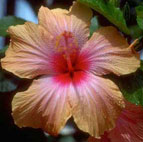 "The
integrated view of the world represented by the mandala, while long
embraced by some Eastern religions, has now begun to emerge in Western
religious and secular cultures. Awareness of the mandala may have
the potential of changing how we see ourselves, our planet, and
perhaps even our own life purpose."
"The
integrated view of the world represented by the mandala, while long
embraced by some Eastern religions, has now begun to emerge in Western
religious and secular cultures. Awareness of the mandala may have
the potential of changing how we see ourselves, our planet, and
perhaps even our own life purpose."
(From Mandala: Journey to the Center, by Bailey Cunningham) creating
unity The Mandala Project workshops for children include the creation of a group mandala quilt. The students enjoy creating individual mandalas that are incorporated into a larger work of art. Creating a group mandala can be an enjoyable activity with friends. It can also provide an excellent closure to an event or workshop. These photos of a beach rock mandala were taken by Mary Ann Rolfe. The mandala was made at the culmination of a week long workshop in August 1998 at Findhorn in the Northern part of Scotland. More
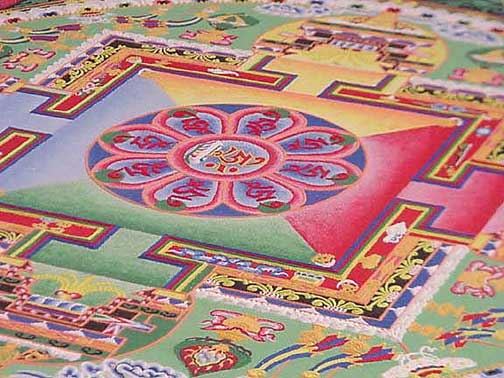
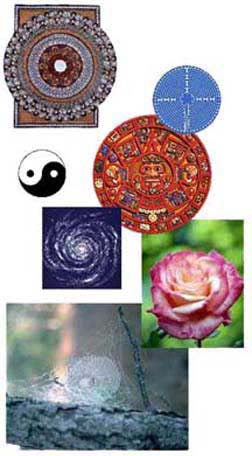
examples of group mandalas: cross-cultural patterns In the Americas, Indians have created medicine wheels and sand mandalas. The circular Aztec calendar was both a timekeeping device and a religious expression of ancient Aztecs. In Asia, the Taoist "yin-yang" symbol represents opposition as well as interdependence. Tibetan mandalas are often highly intricate illustrations of religious significance that are used for meditation. different cultures, similar expressions In ancient Tibet, as part of a spiritual practice, monks created intricate mandalas with colored sand made of crushed semiprecious stones. The tradition continues to this day as the monks travel to different cultures around the world to create sand mandalas and educate people about the culture of Tibet.
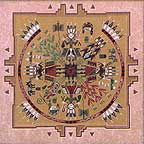
A world away, the American Navajo people also create impermanent sand paintings which are used in spiritual rituals–in much the same way as as they are used by Tibetans. A Navajo sandpainting ritual may last from five to nine days and range in size from three to fifteen feet or more. Learn
more about Tibetan art and culture mandalas
in architecture Native American teepees are conical shapes built around a pole that represents the "axis mundi" or world axis. Buckminster Fuller expanded on the dome design with his famous geodesic dome structures. The dome structure has the highest ratio of enclosed area to external surface area, and all structural members contribute equally to the whole--a great structural representation of a mandala!
Carl Jung said that a mandala symbolizes "a safe refuge of inner reconciliation and wholeness." It is "a synthesis of distinctive elements in a unified scheme representing the basic nature of existence." Jung used the mandala for his own personal growth and wrote about his experiences. It
is said by Tibetan Buddhists that a mandala consists of five "excellencies": An audience or "viewer" is necessary to create a mandala. Where there is no you, there is no mandala. (from: You Are the Eyes of the World, by Longchenpa, translated by Lipman and Peterson). See Links for more information on the mandala |
||||
|
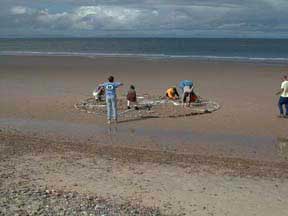 Mary Ann writes about the experience:"We
all brainstormed to decide on a closing project to celebrate the
week and the wonderful connections we had made with people from
all over the world, the Findhorn Foundation and with ourselves.
"At this lovely North Sea beach, instead of sand we found incredible
washed stones of every size and color. So, we began this impromptu
creation knowing that part of the beauty would be in its temporary
nature as the tides washed it away."
See
Mary Ann's
Mary Ann writes about the experience:"We
all brainstormed to decide on a closing project to celebrate the
week and the wonderful connections we had made with people from
all over the world, the Findhorn Foundation and with ourselves.
"At this lovely North Sea beach, instead of sand we found incredible
washed stones of every size and color. So, we began this impromptu
creation knowing that part of the beauty would be in its temporary
nature as the tides washed it away."
See
Mary Ann's 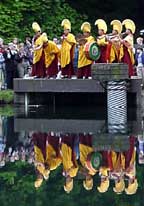 The
creation of a sand mandala requires many hours and days to complete.
Each mandala contains many symbols that must be perfectly reproduced
each time the mandala is created. When finished, the monks gather
in a colorful ceremony, chanting in deep tones as they sweep their
mandala into a jar and empty it into a nearby body of water as a
blessing. This action also symbolizes symbolizes the cycle of life.
The
creation of a sand mandala requires many hours and days to complete.
Each mandala contains many symbols that must be perfectly reproduced
each time the mandala is created. When finished, the monks gather
in a colorful ceremony, chanting in deep tones as they sweep their
mandala into a jar and empty it into a nearby body of water as a
blessing. This action also symbolizes symbolizes the cycle of life.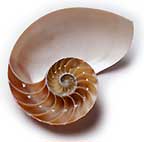 micro
to macro
micro
to macro